

















People doing earthmoving work often have a default judgment: just choose the standard version of a bulldozer—if the blade can push and the tracks can move, the rest depends on the operator's adjustment. This judgment holds in some scenarios, but once it comes to soft ground, hard rock stripping, or bulk material yards, the boundaries of the standard configuration become apparent—not that the machine cannot be used, but that the blade form, undercarriage protection, and traction configuration do not match the work objectives. This article addresses: before deciding on a bulldozer, how to first distinguish which type of earthmoving your work belongs to, and then judge whether the standard version is sufficient.
First distinguish which task the bulldozer undertakes in the project
A bulldozer may play different roles on the same site: pushing blasted overburden to the loading point, short-distance pushing of loose earth, rough leveling of backfill areas, and organizing bulk materials in a yard. The common point of these tasks is that the blade pushes material horizontally, but the material state and work rhythm differ greatly.
- Short push distance, loose material: focus on single-pass push volume and cycle rhythm.
- Hard and compact material, containing gravel: focus on blade wear resistance and undercarriage passability on hard ground.
- Poor site bearing capacity, soft ground: focus on ground pressure and track shoe width.
- Yard organization, bulk material transfer: focus on blade capacity and material flow characteristics.
Standard bulldozers are usually designed for general earthmoving and balance multiple scenarios, but they are not optimized to the limit for a single type of material. If the project only performs one type of work for a long time, the standard configuration may not be the most efficient choice; if the work content itself changes, the versatility of the standard version is valuable instead.
In the information on the standard SD32, which features correspond to general earthmoving needs
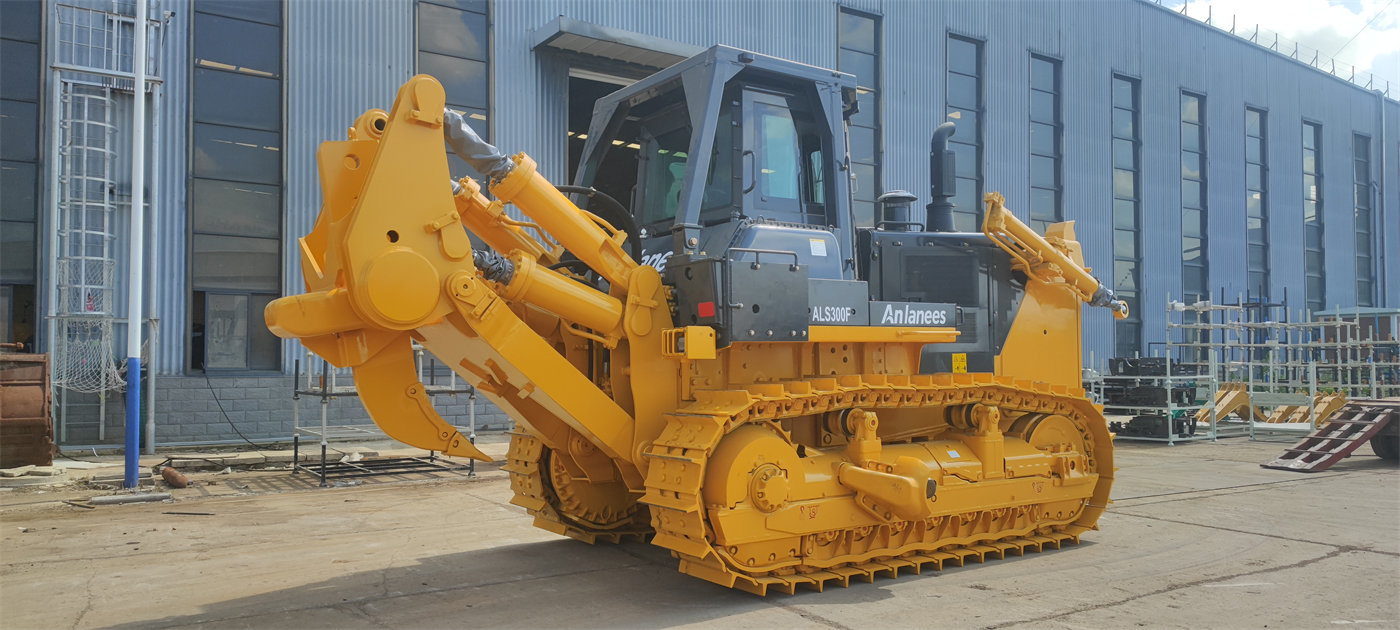
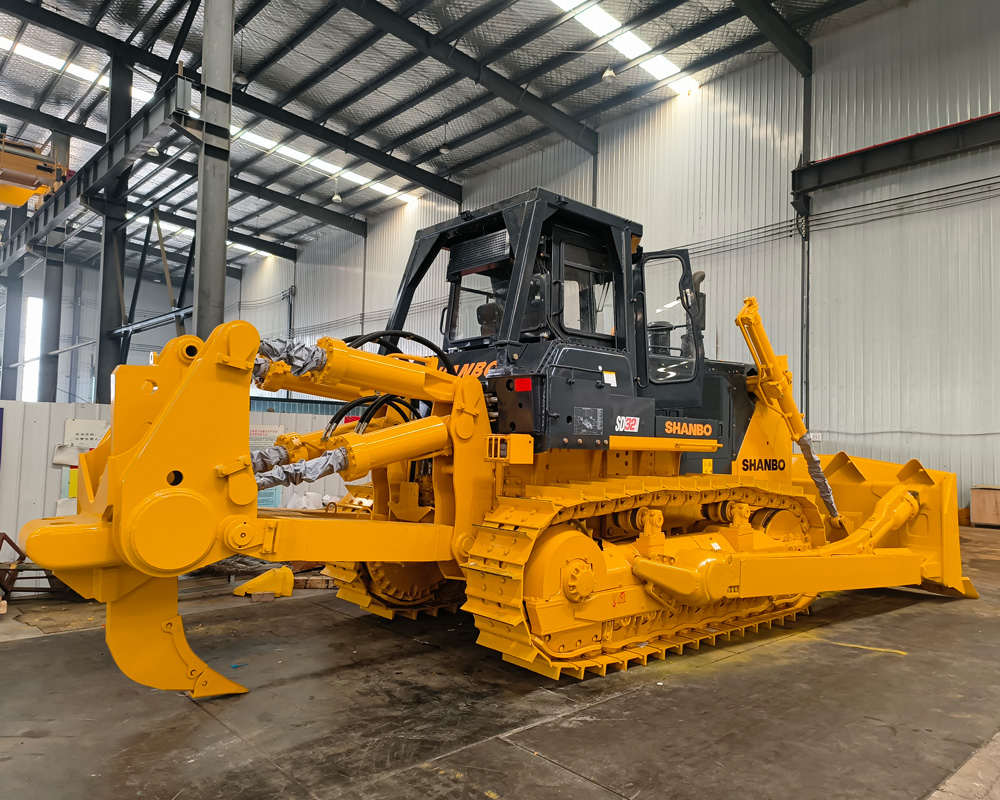
Public information on the SD32 standard bulldozer on this site shows that it is positioned as a 320HP-class crawler bulldozer for various construction sites, with an operating weight of 40200kg (with single-shank ripper and ROPS), ground pressure of 97.7kPa, engine model WP12/QSNT-C345, rated power 257kW/2000rpm, fuel tank capacity 640L, track shoe width options of 560/610/660/710mm, and track ground contact length of 3150mm. Blade types cover straight, angle, and semi-U, and the ripper can be single-shank or three-shank.
These data can be understood on three levels in relation to actual needs:
Power and transmission aimed at continuous heavy load
The rated power of 257kW and large torque reserve correspond to the state in which the whole machine can still maintain pushing when resistance is encountered during pushing. The information mentions that the power transmission assembly matches the engine power curve. Such descriptions cannot be directly converted into efficiency figures, but they can serve as a basis for judgment: if the project requires long-term continuous pushing rather than intermittent work, the power reserve is an item that must be checked.
Undercarriage aimed at multiple ground conditions
The ground pressure of 97.7kPa, ground contact length of 3150mm, and optional track shoe widths determine the machine's passability on general earthmoving ground. The information also mentions 500mm ground clearance and a mature high-strength undercarriage structure. It should be noted that the ground pressure value changes with track shoe width and configuration; during selection, it should be calculated according to the actual configuration, and a single value should not be directly applied to judge adaptability to soft ground.
The work equipment can be changed, but what is changed is the blade, not the whole machine
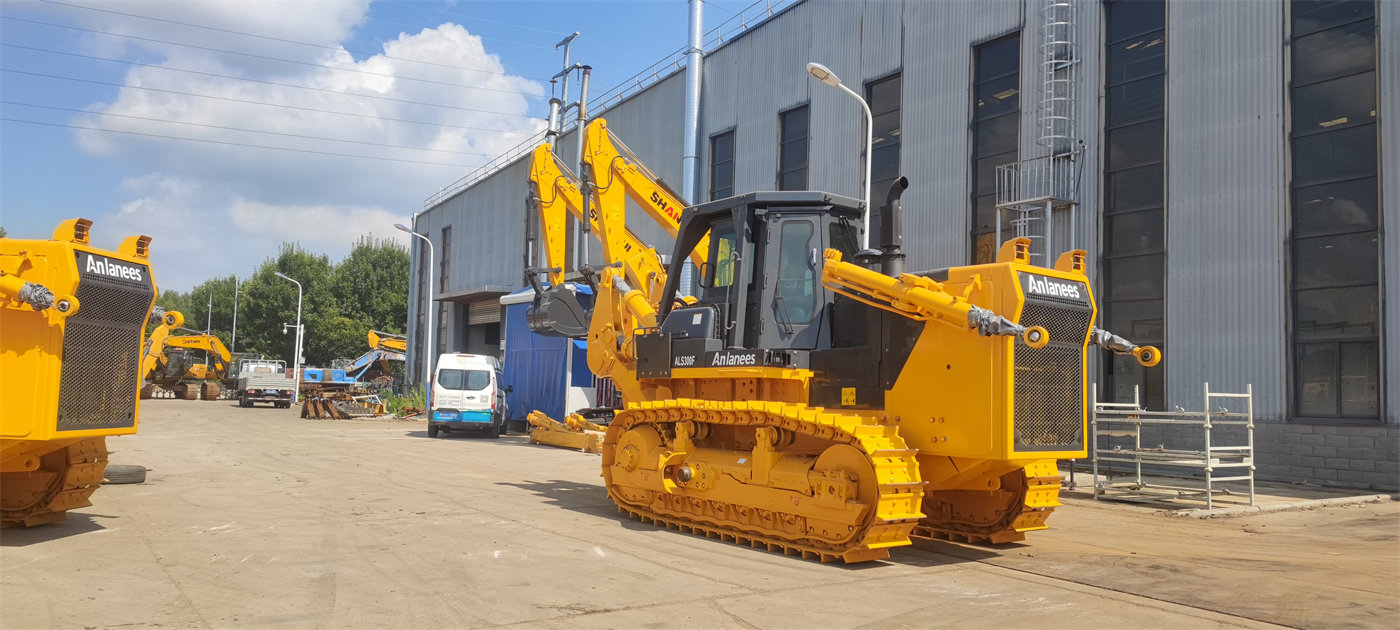
Straight, angle, and semi-U blades cover different action requirements such as pushing, angled pushing, and material gathering. This means the standard version can adapt to some work changes by changing the blade form, but blade replacement cannot change the machine's traction capacity and undercarriage protection level. If the project is mainly hard rock stripping, the gap between the standard undercarriage and general blade and the rock version cannot be closed by changing only one blade.
In which cases the standard version needs to give way
The information also lists the rock, coal, desert, and sanitation versions of the SD32, indicating that different versions under the same power platform target specific materials and environments. This does not mean the standard version cannot be used, but indicates that in some scenarios the match between the standard configuration and the work objectives will decrease.
| Work scenario | Boundaries to check for the standard version |
|---|---|
| Mine rock stripping, weathered rock pushing | Whether blade wear resistance and push arm reinforcement meet continuous contact with hard materials, and whether undercarriage protection is sufficient |
| Power plant and port bulk material yards | Whether blade capacity matches material flow characteristics, and whether track wear resistance corresponds to bulk material abrasion |
| High-temperature, heavy-dust environments | Whether intake filtration and heat dissipation capacity meet environmental requirements, and whether the standard configuration needs additional protection |
| Soft wetlands, backfill areas | Calculate ground pressure according to actual track shoe width, and confirm whether it is within the site's bearing range |
This table is not meant to determine that the standard version is unsuitable, but to list the conditions that should be confirmed item by item before purchase. If the project leans toward one of these categories for a long time, the configuration differences of the specialized version are worth including in the comparison; if the work content indeed rotates among several categories, the versatility of the standard version may be more suitable.
Supporting conditions that are easily overlooked
The work effect of a bulldozer depends not only on the machine itself but also on supporting arrangements. The following points should be considered together at the selection stage:
- Connection with transport vehicles: The distance from the push-gathering point to the loading point determines whether the single-pass push volume can cover the turnover of transport vehicles. The pushing capacity of the standard version needs to be judged in this chain.
- Conditions for using the ripper: The maximum ripping depths of the single-shank and three-shank rippers in the information are 1250mm and 842mm (three-shank), respectively, but whether the ripper can be used depends on material rippability. In hard rock conditions, it should not be assumed by default that the ripper can replace blasting or crushing.
- Safety protection configuration: FOPS&ROPS are optional items, and whether to include them in the configuration should be confirmed according to project safety requirements at purchase.
- Maintenance and spare parts: The information mentions that lubrication and maintenance points are centrally arranged externally, but the spare parts supply cycle and on-site repair conditions need to be confirmed with the supplier.
Items to confirm before purchase
Before including the standard version in the comparison list, it is recommended to first organize the following information clearly. This is also the information that should be provided to the supplier during inquiry:
- Material type and state: loose soil, hard compact soil, gravel-containing mixture, or rock overburden.
- Typical push distance and per-shift work volume, as well as transport vehicle bucket capacity and turnover arrangements.
- Site ground conditions: bearing capacity, slope, and whether soft ground or wetland sections are involved.
- Work shifts and continuous operation duration, and whether day and night construction is required.
- Environmental conditions: dust, temperature, corrosive materials, etc.
- Safety protection and attachment configuration requirements, as well as the engine version corresponding to local emission regulations.
If the above information shows that the project is concentrated in a certain specialized scenario for a long time, the configuration differences of the corresponding version should be further checked; if the project work content is diverse and the intensity of any single type of work is not high, then the general configuration of the standard version has a basis for discussion. The final choice still needs to be confirmed in combination with the configuration list provided by the supplier and on-site conditions, and conclusions should not be drawn based solely on power or tonnage.